
As spring arrives and various flowers begin to bloom, have you ever found yourself confused, wondering if you were looking at one flower or another?
Similar-looking flowers like azaleas and rhododendrons are numerous, but among them, peonies and tree peonies (moutan) are particularly challenging to distinguish.
In the West, the resemblance is so pronounced that both peonies and tree peonies are collectively referred to as “Peony.” However, when a clear distinction is necessary, the peony is known as the Garden Peony, and the tree peony as the Tree Peony.
This time, I want to introduce the differences between peonies and tree peonies in detail and explain how to distinguish these two flowers.
About the Tree Peony
The tree peony is more widely loved in the East than in the West, especially among Koreans and Chinese. It is one of the most familiar flowers to these cultures and is a perennial plant in the peony family.
As spring deepens into May, the tree peony blooms large flowers, displaying a glamorous red beauty. Historically, in the East, it has been cherished as the “king of flowers” or the “flower of wealth and honor.”
Key Differences Between Tree Peonies and Peonies
Although the tree peony is often called the “king of flowers” or the “flower of wealth and honor,” it is similar enough to the peony that it is sometimes referred to as a “woody peony.”
Both tree peonies and peonies belong to the family Paeoniaceae but differ in blooming time, petal shape, and their intrinsic nature as shrubs and herbaceous plants, respectively.
Below, I will explain each of these differences in detail.
Difference Between Shrubs and Herbaceous Plants
The most significant difference between tree peonies and peonies is that tree peonies are deciduous shrubs (trees), while peonies are herbaceous (plants).
This is also the easiest way to distinguish between the two.
The herbaceous peony grows up to about 70 cm tall from the ground, while the tree peony can bloom on trees up to 2 meters tall.
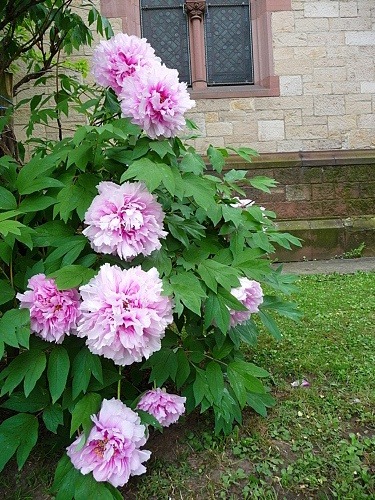
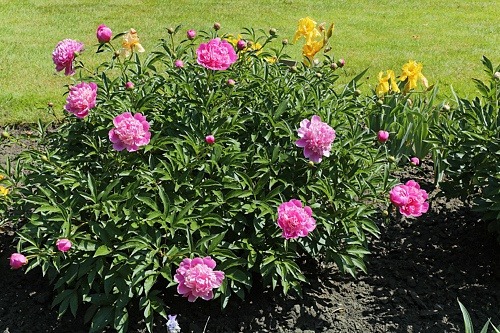
This difference in being a tree or a plant affects how each responds to the seasons.
The leaves of the tree peony are deciduous, and in the fall, the leaves begin to fall, leaving only the tree during winter.
On the other hand, because the peony is a plant, it begins to wither in the fall and dies back to the ground, reemerging and blooming anew in the spring.
Difference in Petals
The petals provide another simple way to distinguish between tree peonies and peonies.
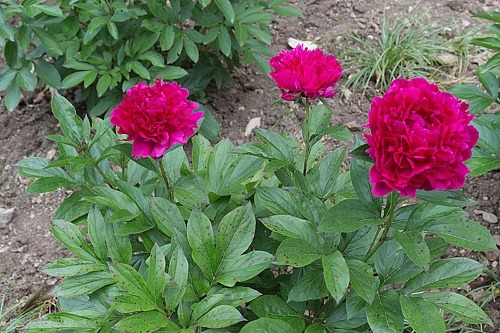
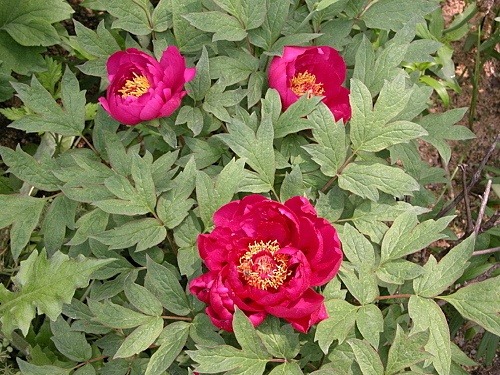
There are differences in the buds, including the pistils and stamens. The buds of the tree peony are much more vibrant and rounded compared to those of the peony.
However, the leaves offer an even clearer distinction.
As mentioned, the leaves of the tree peony are deciduous and lack sheen, whereas the leaves of the peony are distinctly glossy.
Difference in Blooming Time
Previously, blooming time could roughly differentiate tree peonies and peonies. Tree peonies bloom from April to May, while peonies bloom later, around June.
However, blooming time alone is not enough to perfectly distinguish the two flowers.
For one, there are over 1,000 varieties of tree peonies alone, and there are many hybrid varieties between peonies and tree peonies. Moreover, recent climate changes have caused blooming times to shift earlier or later.
Why not decorate your home with a tree peony painting to invite wealth and prosperity?